When Buying More Actually Costs You More: The Truth About Bulk Receipt Paper for Small Retailers
Every small business owner has heard the pitch: buy in bulk, save big. It works for napkins, printer ink, and trash bags. But receipt paper? That's where the conventional wisdom starts to crack. Thermal paper rolls have a set of quirks that make the bulk-buying equation a lot messier than it looks on a supplier's price sheet — and for a surprising number of small retailers, stocking up actually ends up costing more than buying smart in smaller quantities.
Let's break down why.
Thermal Paper Has a Shelf Life — And It's Shorter Than You Think
Here's something that doesn't make it onto most product listings: standard thermal receipt paper typically has a usable shelf life of around one to three years, depending on storage conditions. That sounds like plenty of time — until you factor in how it was stored before it reached your shelf.
Thermal paper is heat-sensitive by design. That's how it prints without ink. But that same sensitivity means it degrades when exposed to warmth, humidity, direct sunlight, or even certain chemicals. A roll that sat in a warehouse in Phoenix through a July heatwave may already have burned through a chunk of its usable life before you ever open the box.
For a high-volume retailer printing hundreds of receipts a day, this isn't much of a problem — you'll burn through inventory fast enough that degradation barely registers. But for a small boutique, a food truck, or a seasonal pop-up shop printing maybe 20 to 30 receipts on a busy Saturday? A 50-roll case could easily sit in your supply closet for two or more years. By the time you're on your last dozen rolls, you might be handing customers faded, barely-legible receipts — which is both a customer experience problem and, depending on your state's receipt requirements, a potential compliance headache.
The Storage Cost Nobody Talks About
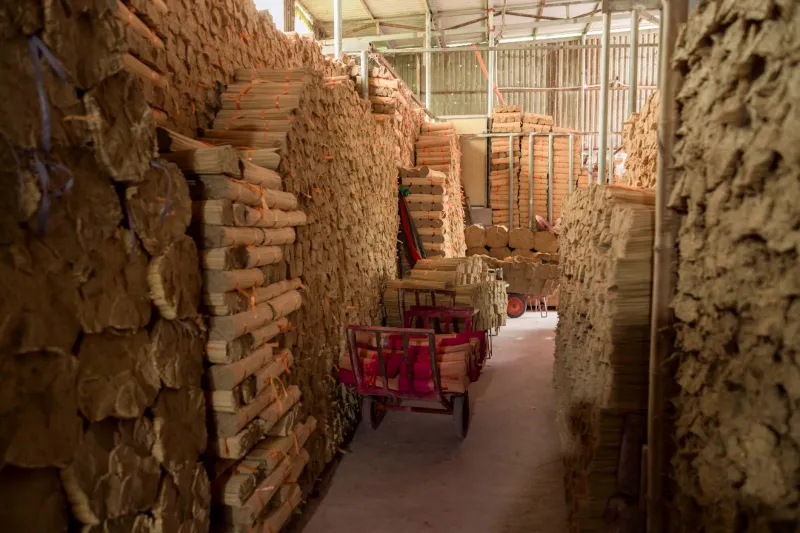
Receipt paper rolls aren't heavy, but they're bulky. A case of 50 standard 3 1/8" x 230' rolls takes up real space — space that, in a small retail environment, has real value. Whether you're paying rent on a back room, renting a storage unit, or just crowding out other supplies, there's a cost to storing inventory that rarely shows up in bulk-buying math.
Retail consultants sometimes call this the "hidden holding cost" — the combination of storage space, the risk of damage or theft, and the capital you've tied up in product that isn't moving. For a business running lean, locking $200 or $300 into a receipt paper stockpile means that money isn't available for something with a faster or more meaningful return.
This doesn't mean bulk buying is always wrong. It means the calculation needs to include more than just the per-roll price.
Your Printer Situation Is Probably Going to Change
Receipt printer technology isn't static. Businesses upgrade hardware, change POS systems, or switch to digital receipt options more often than they expect. And here's the problem: receipt paper rolls aren't universal. Different printers take different roll widths and core sizes. A 3 1/8" roll doesn't fit a printer that takes 2 1/4". A roll with a 0.5" core won't seat properly in a printer designed for a coreless roll.
If you've stocked up on 80 rolls calibrated to your current printer and then upgrade your POS system six months later — a scenario that plays out constantly in small retail — you could be sitting on inventory that literally doesn't fit your new setup. That's not a savings. That's a write-off.
Smaller, more frequent orders give you flexibility. You're not locked into a specification that may not match your hardware six months from now.
Seasonal Demand Makes Bulk Timing Tricky
Receipt paper consumption isn't flat. It spikes during busy seasons — holiday retail, summer for restaurants and outdoor vendors, tax season for service businesses. The temptation is to bulk-buy right before a busy stretch, which makes sense. But the timing has to be precise.
Buy too early and your paper is sitting in storage through slow months before the rush hits, accumulating holding costs and exposure time. Buy too much and you're managing leftovers long after the season ends. The businesses that handle this best tend to use a just-ahead-of-demand model: ordering enough to comfortably cover a busy period with a modest buffer, then reordering based on actual usage rather than optimistic projections.
For genuinely seasonal businesses — farmers market vendors, holiday pop-ups, summer beach shops — the math almost always favors smaller, targeted orders over large annual buys.
So When Does Bulk Actually Make Sense?
To be fair, bulk purchasing isn't categorically bad. It just requires the right conditions:
- High, consistent volume. If you're printing 500+ receipts a day, seven days a week, you'll cycle through inventory fast enough that shelf-life degradation is a non-issue and the per-roll savings genuinely add up.
- Stable printer setup. If you've been running the same POS hardware for years and have no plans to change, buying a larger stock of the exact roll you need carries less risk.
- Proper storage. A climate-controlled storage room away from heat, humidity, and chemical exposure extends paper life significantly. If you have that setup, bulk buying becomes much more defensible.
- Predictable demand. Businesses with steady, year-round traffic have an easier time projecting how much inventory they'll actually use — making bulk purchases less likely to result in waste.
For everyone else — the boutique with variable foot traffic, the restaurant that just upgraded its POS, the mobile vendor who works weekends — a more measured approach tends to win.
The Smarter Play for Most Small Retailers
Instead of chasing the lowest per-roll price on a giant case, consider a middle path: buy in moderate quantities aligned to roughly 60 to 90 days of actual usage, and order more frequently. Yes, the per-roll cost might be slightly higher. But when you subtract the storage overhead, the risk of degradation, and the flexibility you gain, the real-world cost often lands lower than the bulk-buy alternative.
Sites like Free Receipt Paper are built around this idea — giving small businesses access to quality thermal paper without forcing them into oversized commitments that don't fit how they actually operate. The goal isn't to sell you the most paper. It's to help you spend the least on the paper you actually need.
Bulk buying is a tool, not a strategy. For receipt paper specifically, knowing when to use it — and when to skip it — is one of those small decisions that quietly adds up to real money over time.